
The Early Voting Ballot Board decides which ballots in Tarrant County are accepted and which are rejected, and despite its name, its work is not limited to early voting or mail-in ballots. The Board qualifies every ballot voted by mail, including those from military and overseas voters, reviewing signatures and ID information and notifying voters so they can fix defects before a ballot can be rejected. It also reviews every provisional ballot, including those cast in person on Election Day, and rules on whether each one counts. The Board meets before, on, and after Election Day, and in a November general election its work can continue up to 13 days after the polls close. Texas law builds party balance into that room on purpose, so no single party handles your ballot without someone else watching.
The law is not vague about this. Under Texas Election Code §87.002(c), the county chair of each party with nominees on the general election ballot submits a list of people eligible to serve on the Ballot Board, ranked in order of preference. The county election board must appoint at least one person from each list, and “the same number of members must be appointed from each list,” drawn in the order each party ranked them. The presiding judge and alternate presiding judge are chosen separately, from the top of the lists submitted by the two parties whose candidates for governor received the most votes in the county. Those two leadership seats are filled in addition to the regular members and do not change the equal-numbers rule for everyone else. The Texas Secretary of State’s own handbook for the Early Voting Ballot Board spells out the same requirements.
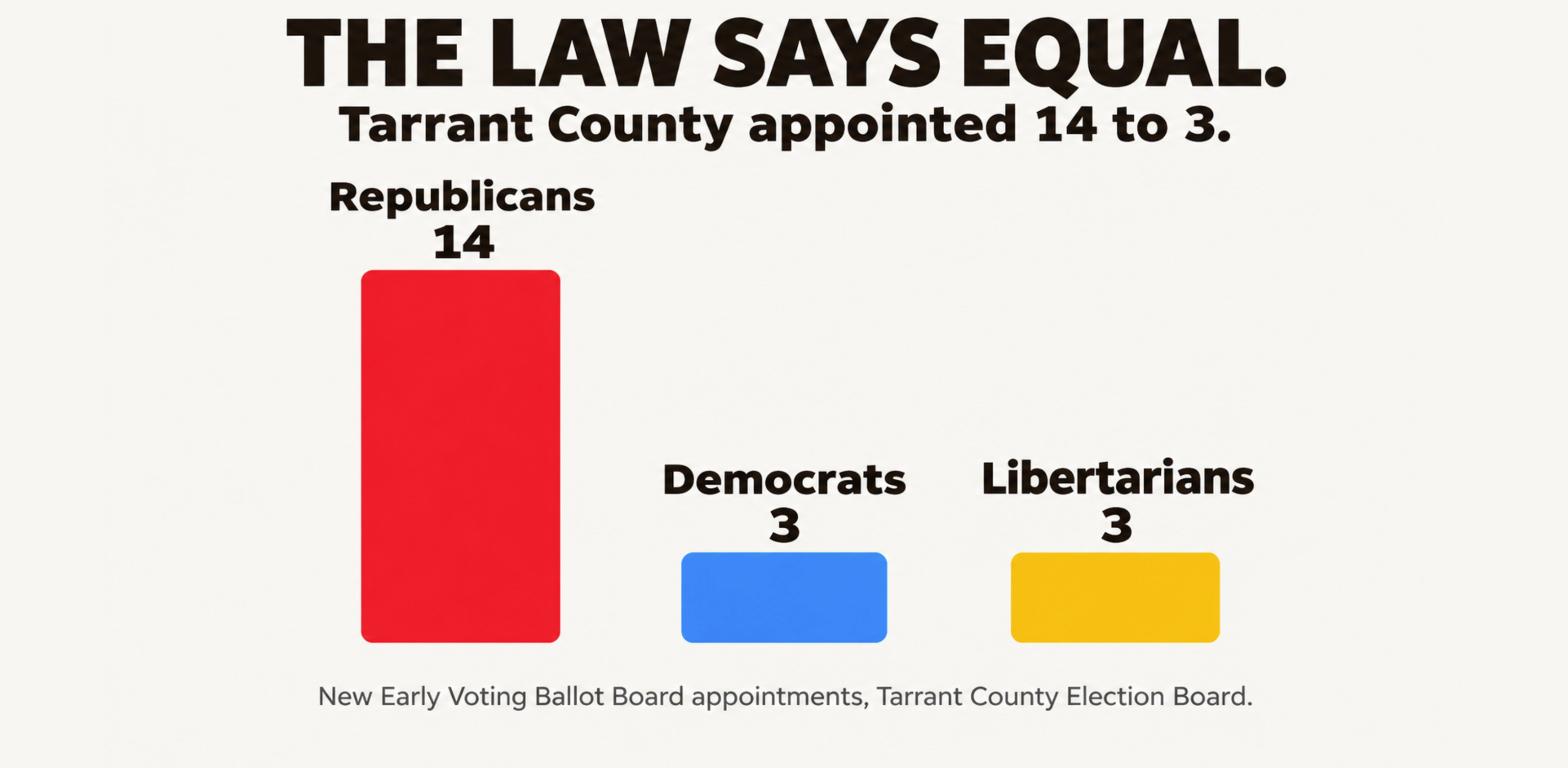
At its latest meeting, the Tarrant County Election Board appointed new members to the Ballot Board: 14 Republicans, 3 Democrats, and 3 Libertarians. Of those 20 appointments, 14 went to a single party. That is 70 percent of the seats, more than four times as many as either other party received, and more than twice as many as the other two parties combined. The statute leaves no room for that kind of math. Equal means equal, whether that is 3, 3, and 3 or 14, 14, and 14. This is not close to equal, and it is not a judgment call. It is the opposite of what the statute requires.
There has been progress on one front. After sustained public pressure, the presiding judge has begun scheduling Libertarian members to serve. We welcome that. But it happened only because people showed up and spoke out, and nothing in place today stops the schedule from going back to the way it was. A seat that exists only at one official’s discretion is not a seat the law protects.
Balance matters for a reason. Every Ballot Board member swears an oath under §87.006 that they “will not work alone when ballots are present,” and will work only alongside a member of a different party. Equal appointments are what make that promise possible to keep.
We are fighting for two things. First, a Ballot Board appointed the way §87.002(c) requires, with the same number of members from each party’s list. Second, Libertarian members who are appointed must actually be scheduled to serve, for the rest of this election and the elections that follow.
Holding officials to the plain text of the law takes lawyers, filings, and public records requests, and it has to move on the election’s calendar, not ours. Your contribution keeps this fight going.
In the news: Libertarians allege political discrimination in Tarrant County midterm ballot review process (Fort Worth Report, Oct. 30, 2026)
Read the law: Texas Election Code §87.002 · §87.006 · Texas Secretary of State, Handbook for Early Voting Ballot Board